Racism without Racists: Color-Blind Racism and the Persistence of Racial Inequality in America by Eduardo Bonilla-Silva
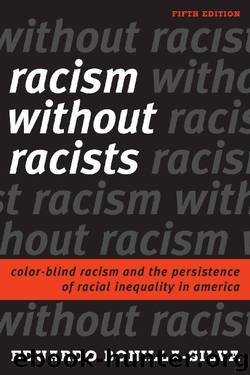
Author:Eduardo Bonilla-Silva [Bonilla-Silva, Eduardo]
Language: eng
Format: epub, azw3
Publisher: Rowman & Littlefield Publishers
Published: 2017-06-09T04:00:00+00:00
9
E Pluribus Unum, or theSame Old Perfume in a New Bottle?
On the Future of Racial Stratification in the United States
What Does All the Racial Noise Mean? A Sketch of Things to Come
Latinos are now officially the largest minority group in the nation. According to the Census Bureau, while blacks comprise 13 percent of the U.S. population, Latinos are 16.3 percent.1 This Latino population explosion, generated by immigration, has already created a number of visible fractures in the United States that seem to be shifting the racial terrain. In academic circles, for instance, conservative scholars have begun attacking the new racial demography as devastating for the future of the country. An example of these scholars is Harvard’s political scientist Samuel Huntington, who in his recent book, Who Are We? The Challenges to America’s National Identity, argued that Latino immigration threatens Anglo-Saxon American culture as well as the political integrity of the country.2 And politicians in both parties as well as prominent newscasters such as Lou Dobbs—since 2003 or so, he has addressed every night the topic of illegal immigration in his show Lou Dobbs Tonight in his nightly segment “Broken Borders”3 and almost all Fox News commentators (e.g., Brit Hume, Tony Snow, Sean Hannity, John Gibson, and Fox’s most vitriolic newscaster, Bill O’Reilly) articulate and inflame the anti-immigrant fears for the wider public.
In addition to the Latino population explosion, other trends have emerged that challenge our traditional biracial divide (white vs. nonwhite) and, more specifically, our black-white understanding of racial politics in the United States. For example, another group that has gained visibility in our racial discussions is Asian Americans, partly because of their demographic gains (they are now 5 percent of the population), partly because as a group, they are perceived as doing very well economically and educationally, and, more importantly, partly because they are still viewed by most Americans through the lenses of developments in South East Asia.4 On this last point, the commercial rise of Japan and, particularly, of China, has generated a fear of the East that can be seen in movies (e.g., Red Corner [1997], Mulan [1998], etc.), political scandals, and in the way China is discussed almost every night in the news.5
Yet another illustration of the changing racial terrain in the United States is our recent national discussion on the status of “multiracial” and “biracial” people.6 Two events shaped our collective engagement on these matters over the last ten years. First, phenom golfer Tiger Woods, son of a black father and a Tai mother, made a public statement suggesting he was not black but rather “Cablanasian” (a mixture of Caucasian, black, and Asian). This led to a furious public debate on what it means to be “black” or “mixed” and whether or not people could claim a racial identity other than those already inscribed in our racial pentagram. (Who had ever heard of such a thing as a Cablanasian?) Second, the struggle by people in the multiracial movement7 to force changes in the way
Download
Racism without Racists: Color-Blind Racism and the Persistence of Racial Inequality in America by Eduardo Bonilla-Silva.azw3
This site does not store any files on its server. We only index and link to content provided by other sites. Please contact the content providers to delete copyright contents if any and email us, we'll remove relevant links or contents immediately.
| Anthropology | Archaeology |
| Philosophy | Politics & Government |
| Social Sciences | Sociology |
| Women's Studies |
Cecilia; Or, Memoirs of an Heiress — Volume 1 by Fanny Burney(32562)
The Great Music City by Andrea Baker(32023)
Cecilia; Or, Memoirs of an Heiress — Volume 2 by Fanny Burney(31959)
Cecilia; Or, Memoirs of an Heiress — Volume 3 by Fanny Burney(31945)
We're Going to Need More Wine by Gabrielle Union(19053)
All the Missing Girls by Megan Miranda(16052)
Pimp by Iceberg Slim(14522)
For the Love of Europe by Rick Steves(14174)
Bombshells: Glamour Girls of a Lifetime by Sullivan Steve(14081)
Norse Mythology by Gaiman Neil(13379)
Talking to Strangers by Malcolm Gladwell(13376)
Fifty Shades Freed by E L James(13247)
Mindhunter: Inside the FBI's Elite Serial Crime Unit by John E. Douglas & Mark Olshaker(9349)
Crazy Rich Asians by Kevin Kwan(9297)
The Lost Art of Listening by Michael P. Nichols(7509)
Enlightenment Now: The Case for Reason, Science, Humanism, and Progress by Steven Pinker(7316)
The Four Agreements by Don Miguel Ruiz(6770)
Bad Blood by John Carreyrou(6626)
Weapons of Math Destruction by Cathy O'Neil(6284)
